
Published in Frontiers (Volume 19, 2025), Yang et al. (2025) presented a study examining how information-processing load influences the accuracy of decisions and conclusions in complex decision-making contexts, using a Photon Cap C20 fNIRS device to measure prefrontal-cortex blood oxygenation.
Introduction
Yang et al. (2025) acknowledge that in engineering design, decision-making tasks often require collaboration among multidisciplinary teams. Differences in the knowledge structures of various disciplines can lead to ambiguities or misunderstandings of specialized terminology and concepts – meaning discrepancy – leading to communication barriers that may ultimately affect the quality of final decisions.
The research team suggests that such communication failures occur due to cognitive conflict induced by increased cognitive load.
Previous studies of decision-making paradigms have explored managerial influence theories and behavioral analyses, however, the cognitive and neural mechanisms of interdisciplinary group decision-making were largely unexplored.
To fill in this gap, Yang et al. (2025) developed an experimental Multi-Attribute Decision-Making with Layered Group Dynamics (MADM-LGD) task – a decision path model that connects diversity of meaning interpretations with cognitive conflict, increased cognitive load, and reduced communication efficiency.
This study uses fNIRS to track prefrontal oxygenation, integrating semantic and linguistic analyses to explore how cognitive level and interdisciplinary communication shape the quality of group decision-making.
The experiment
Participants
The study involved 54 participants, including 25 undergraduates, 21 master’s students, and 8 doctoral students from universities in Shanghai. Participants were organized into 18 groups of three members each. The final selection consisted of 34 males and 20 females, all of whom had recent experience working or interning in engineering companies.
Procedure
To understand how different decision-making factors affect the quality of choices, Yang et al. (2025) used MADM-LGD task, designed to imitate a cruise ship cabin crew interaction, hence group decision-making dynamics.
The experiment lasted for a month in the summer of 2024, and was carried out in an independent, quiet laboratory environment, where the researchers were collecting and analyzing Oxy-Hb levels data using Photon Cap C20 fNIRS technology.
The procedure consisted of two decision-making phases (individual and group) and a total of seven stages with brief breaks, as illustrated in the overall flowchart (Yang et al., 2025) below.

The full sequence of procedural steps. (Figure 2 in Yang et al., 2025)
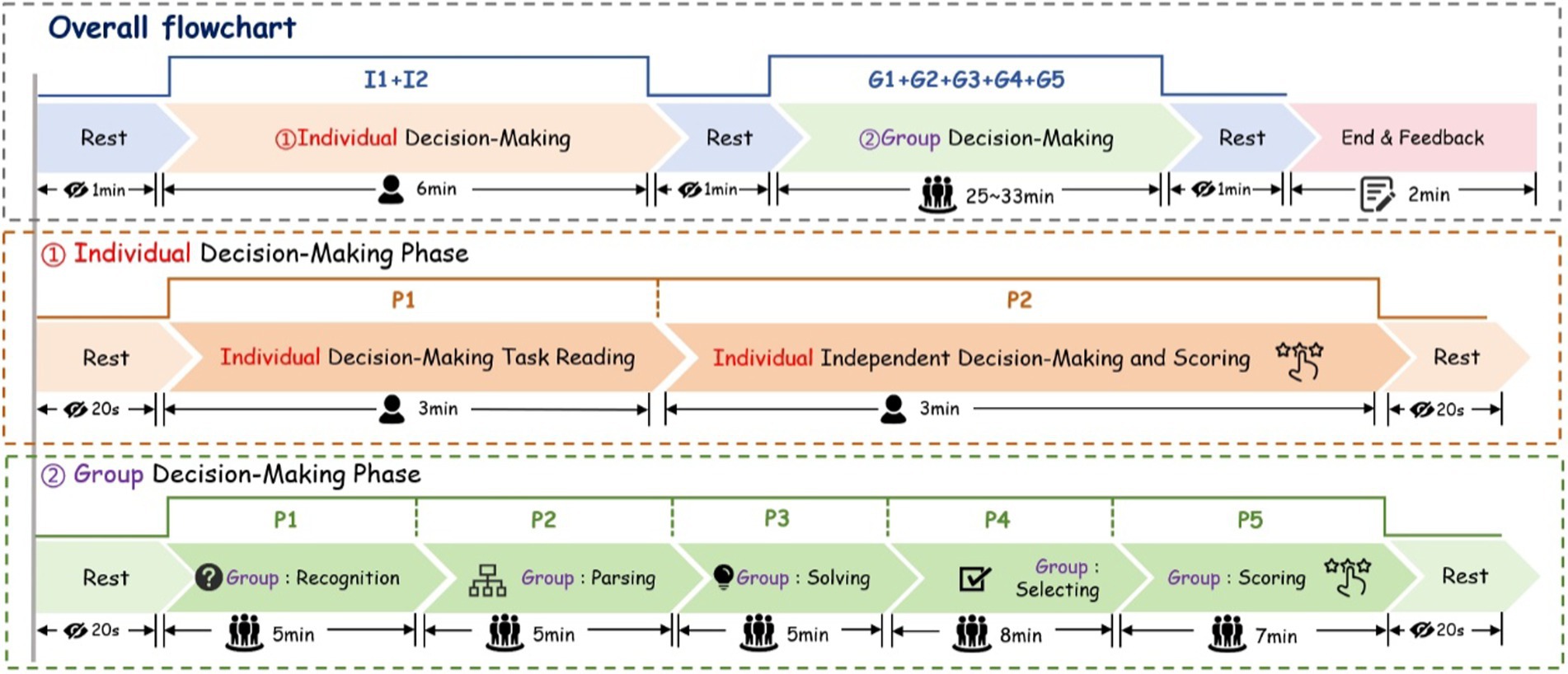
- an individual phase (I1–I2) – making the individual decisions independently in accordance with the previously briefed instructions within the three-minute periods (Individual phases P1 and P2).
- a group phase (G1–G5) – conducting several group discussion-making rounds to compare and select the most effective scheme among the provided ones, followed by individual scoring for all selected schemes afterwards (Group phases P1 to P5).
The fluctuations of Oxy-Hb levels were measured by Photon Cap across all seven stages divided into individual (I1 to I2) and group (G1–G5) stages accordingly. The duration of the test session was approximately 45 minutes in total, divided into alternating intervals of cognitive stimulation and rest.
Data acquisition
As mentioned earlier, Yang et al. (2025) used Photon Cap C20 along with the Cortivision Pathfinder to measure cortical hemodynamic activity during both resting and decision-making conditions to monitor changes in Oxy-Hb levels, with participants sitting quietly with eyes closed during resting phases to allow Oxy-Hb levels to return to baseline.
For greater precision, an enhanced “10–5 system” was used to place optodes over prefrontal regions of interest (ROIs) such as frontopolar (FOA), pars triangularis Broca (PTBA), dorsolateral prefrontal cortex (DLPFC), and inferior prefrontal gyrus (IPFG).
Overall, the montage consisted of 22 channels with 8 light sources and 8 detectors.

Photon Cap channel layout over the frontal lobe during the procedure.
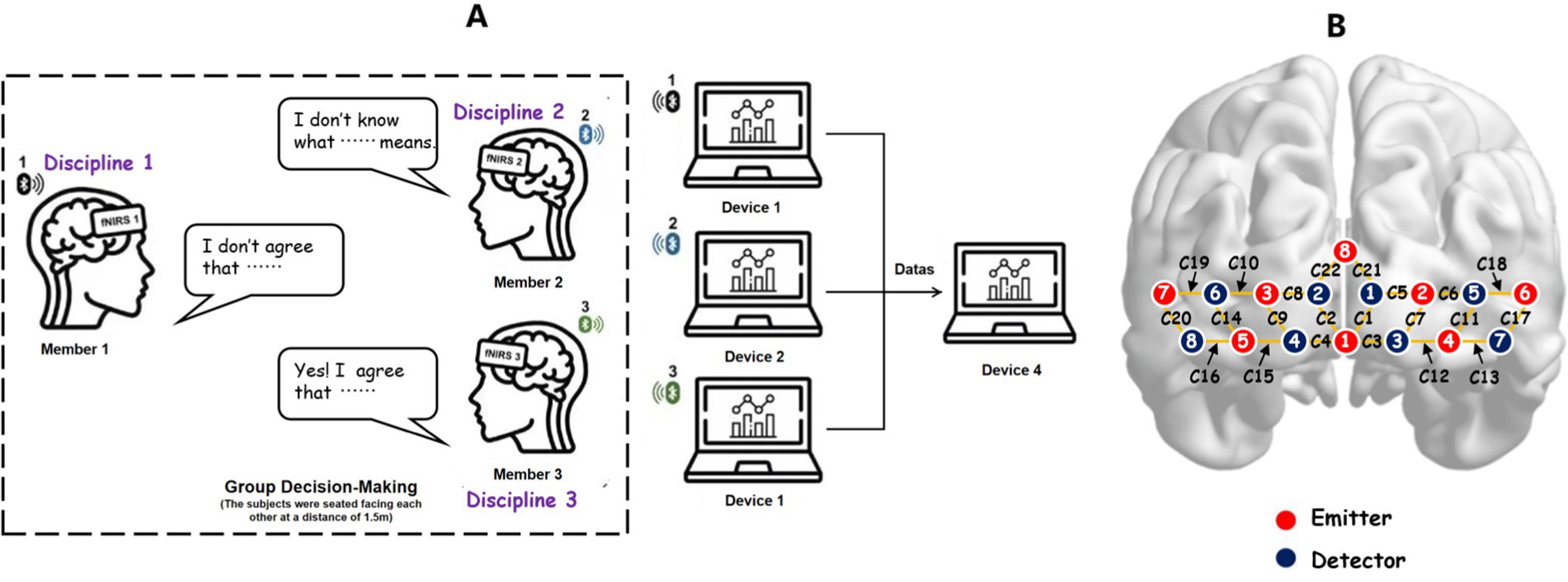
Collected data included participants’ profile information (gender, age, handedness), dialogue texts from interdisciplinary group discussions, and cortical Oxy-Hb concentrations during the MADM-LGD task.
Outcome
Using Photon Cap the researchers identified that activation was mainly concentrated in the frontopolar area (FOA), especially during transitions between individual and group decision-making. Significant differences in averaged Oxy-Hb levels were observed across all seven stages I1 to I2 and G1 to G5 accordingly. Brain activity increased from individual stage I1 to I2, then dropped as participants moved into the group stages (G1–G5), suggesting a shift in cognitive effort and strategy use.
According to Yang et al. (2025) these findings indicate that individual decision-making demanded higher cognitive load, while group collaboration tended to reduce it – highlighting the neural basis of how collaboration can ease mental strain, relieve pressure, improve performance, promote clearer understanding and better overall decision quality.
The Photon Cap proved effective for examining cognitive load, and Yang et al. (2025) suggest that future studies combine fNIRS and eye-tracking to gain deeper insights into cognitive control and visual attention in interdisciplinary group decision-making.
This blog post is based on open-access publication: Yang, J., Jiang, Z., Cheng, K., & Wu, L. (2025). Disciplinary barriers need communication: A behavioral and fNIRS study under group decision-making paradigm shift based on cabin design. Frontiers in Neuroscience, 19, 1594111. https://doi.org/10.3389/fnins.2025.1594111